TRKA
An original comic universe, a course catalogue, and the storefront that holds them together.
I started TRKA as a set of short courses and it became something harder. Twenty-eight comic issues, thirteen courses, a community, and the commercial and legal machinery underneath. I made all of it, which meant every decision had to answer to every other one. The interesting problem was never the storefront. It was making a generative tool hold a story together.

Replacing a studio
The stories are mine. Every arc, every character, every line of dialogue came out of my head — generative tools have no narrative instinct, and inventing one for them is not something you can prompt your way into. What they produce is images, and they need to be told exactly what.
A comic normally needs a writer, an editor, a penciller, a colourist and an art director. Courses need a scriptwriter, a narrator, an editor. Marketing needs a copywriter and a designer. I had a generative tool and myself. My work was not making any of it — it was doing every one of those jobs and keeping them from contradicting each other.
The tool’s memory is unreliable. Sometimes a character survives between generations, sometimes the face shifts, the armour changes, the age drifts. Sometimes everything moves at once. Across twenty-eight issues that breaks the reader’s belief that they are looking at a world rather than a sequence of unrelated pictures. Whatever consistency exists has to come from outside the tool. That is the part nobody sees, and the part that takes the time.

Specification as method
What I arrived at was specification: describing every element in enough detail that the same description reproduces the same result. Not prompts in the casual sense — written definitions that survive being regenerated. Face, build, clothing, palette, lighting. The ratio of realism to stylisation, held at a fixed point per era. Line weight. The register of the dialogue. The things that must not move.
I discard between five and twenty generations for every image that survives. The discard rate is the method. The tool proposes images. I wrote the world they belong to, and I decide what becomes canon.

Five visual eras
The visual language shifts as the story darkens — painterly fantasy, dark medieval realism, cosmic superhero, gothic horror, cinematic graphic novel. Each era is a deliberate specification change, not a drift. I move the style when the narrative earns it.
Chronicle 1 runs across four arcs: The Fall of Arkenhelm, The Celestial War, The Witch Hunter, The Blood Trials. I built a Power Archive documenting every character — origins, alignments, abilities, power levels — which doubles as the reference that keeps them consistent.

Painterly Fantasy

Dark Medieval Realism
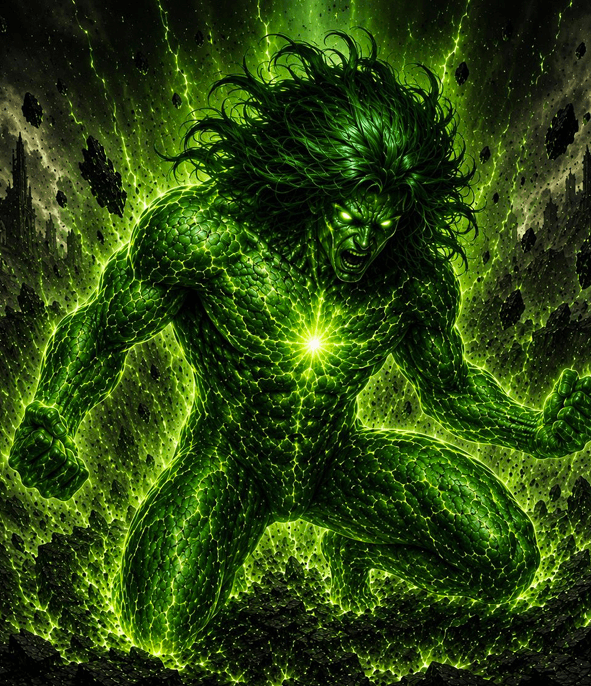
Cosmic Superhero

Gothic Horror
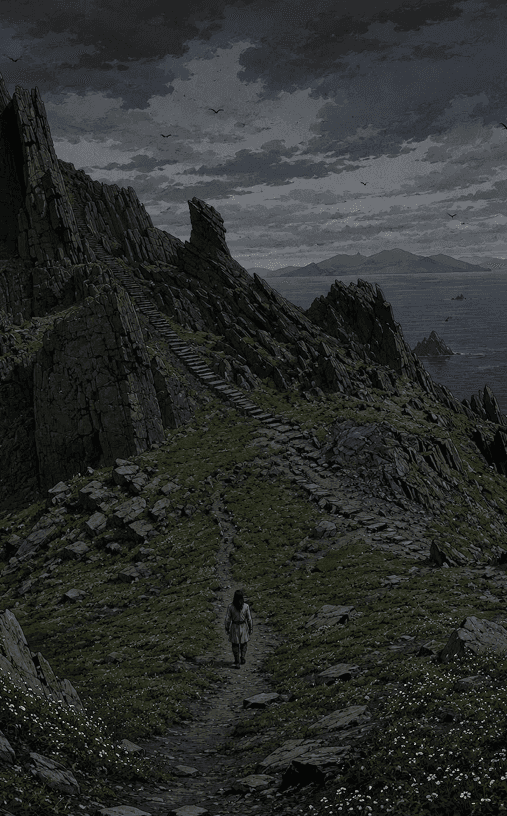
Cinematic Graphic Novel
Knowledge
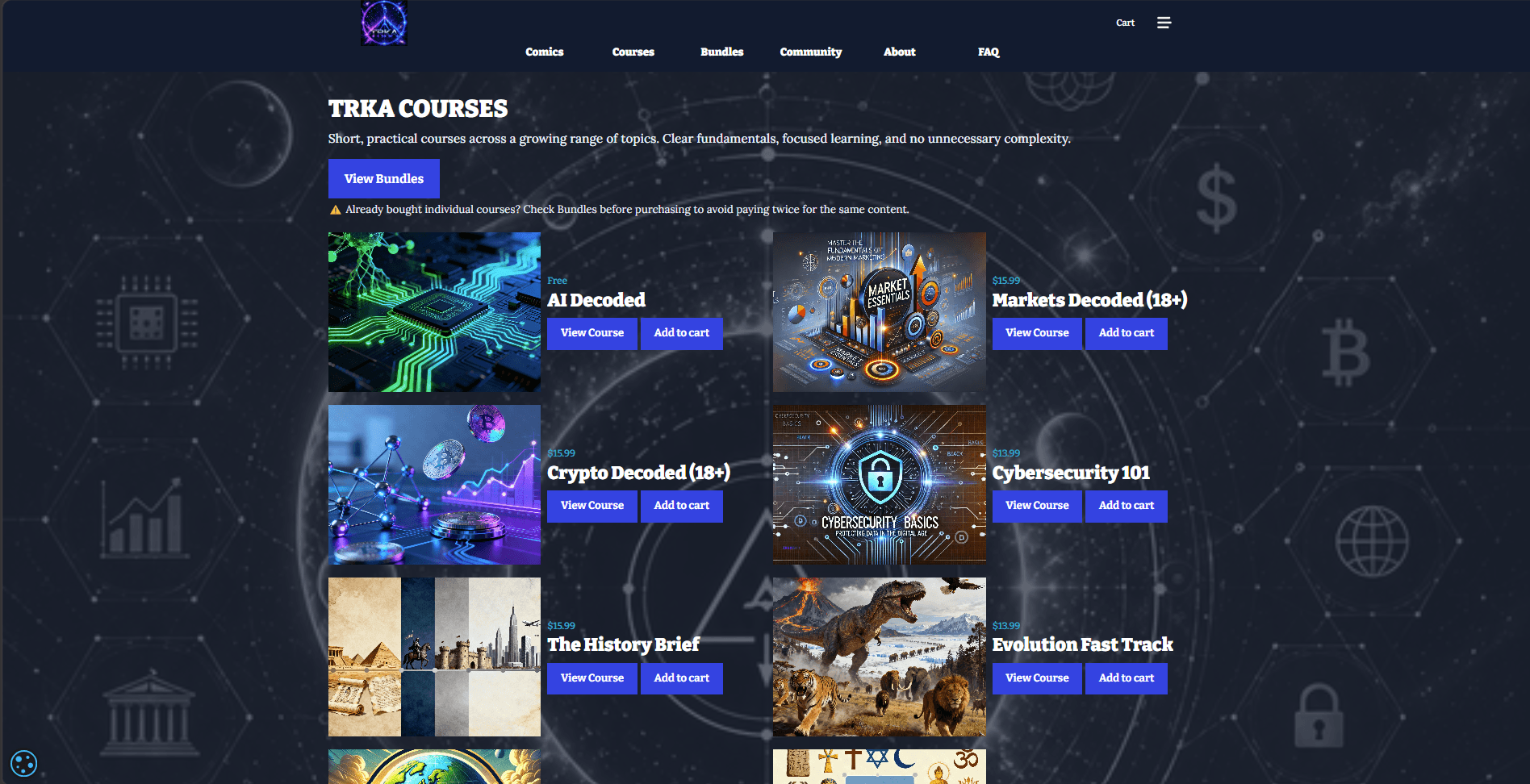
Thirteen short courses across AI, cybersecurity, programming, markets, psychology and history, packaged into thematic bundles. I positioned them honestly: the site states plainly that the courses are unaccredited and do not replace universities or expert instruction. Overclaiming would have been easy and would have cost more than it earned.
Community
A Discord server sits underneath the whole project — readers of the comics, people taking the courses, and conversations that belong to neither: AI, history, science, whatever comes up. It’s the layer that turns a storefront into something people come back to, and the only part of TRKA that grows without me publishing anything new.

Why three products and not one
Digital goods cost nothing to reproduce, which makes the real constraint attention rather than inventory. That changes what a catalogue is for. A single comic competes with every other comic for the same reader; a comic that sits beside courses and a community competes for their time once and then keeps it. The marginal cost of adding the second product is close to zero, and the marginal value is the reason someone stays.
That logic set the rest: free tiers on both halves because copies are free and attention isn’t, bundles priced below their parts because the second sale costs nothing to make, and a community underneath both because retention is cheaper than acquisition at any price point. None of it was guesswork. It followed from what digital products actually are.
Finding the audience
I tested TRKA across a dozen channels — Reddit, Discord, WhatsApp, Facebook, X, Instagram, YouTube, Rumble — alongside paid campaigns on Google and Meta, funded out of my own pocket. The lesson came fast: at a low ticket price, paid acquisition is arithmetic that rarely closes. A thirteen-dollar product cannot carry a cost-per-acquisition set by an auction against companies selling subscriptions.
What worked was different. Give something away that costs nothing to copy, let the story do the persuading, and make the second purchase cheaper than the first. A comics audience and a course audience behave nothing alike, and the same post lands differently on each platform. I learned that by watching it fail on most of them.
Changing it as I learned
The project was called The Real Knowledge Academy before it was TRKA — a name that promised institutional weight I had no intention of claiming. I rebuilt the storefront around what buyers actually needed: visible course outlines before purchase, a free entry point on both halves of the catalogue, honest trust signals instead of decorative security badges, and a bundle placed at the paywall rather than buried in a menu. Most of those changes came from looking at the site the way a stranger would and finding it wanting.
What people kept asking
Once people started using TRKA, the same questions kept reaching me: from friends, from family, from anyone who tried it. Where do I log in? Why did a different page open? Why is this comic called a course? None of them were bugs. Each was a point where the site assumed something a newcomer didn’t know. I collected them into an FAQ in English and Spanish, and wrote each answer around the exact moment of confusion.
Designing the funnel
The first six issues of Chronicle 1 are free, and one of the courses too. Readers reach the paywall already invested, and I placed the complete Chronicle bundle at exactly that moment — 40% below the cost of buying issue by issue. The courses work the same way: thirteen thematic bundles priced below the sum of their parts, so the second purchase is always cheaper than the first. The free tier isn’t generosity; it’s the acquisition channel.

What it took to run
Domain, DNS and CDN configuration. A commerce platform I configured rather than built — Stripe payments, account-gated content, parallel English and Spanish course trees maintained separately rather than machine-translated. Terms of Service, Privacy Policy and Cookie Policy I wrote from scratch, covering EU and Spanish consumer withdrawal rights, refund guarantees and intellectual property. None of this is the interesting part. All of it had to be right before anything else could exist.
One ecosystem
Comics, courses and community are three products that share one audience. A reader who arrives for the story finds the courses; someone who arrives for a course finds a world. Each part makes the others cheaper to reach — which is the whole reason to build them together rather than separately.
See it running
A two-minute walkthrough of the site.
Founder & sole builder · Podia, Stripe, Cloudflare · 2025–present